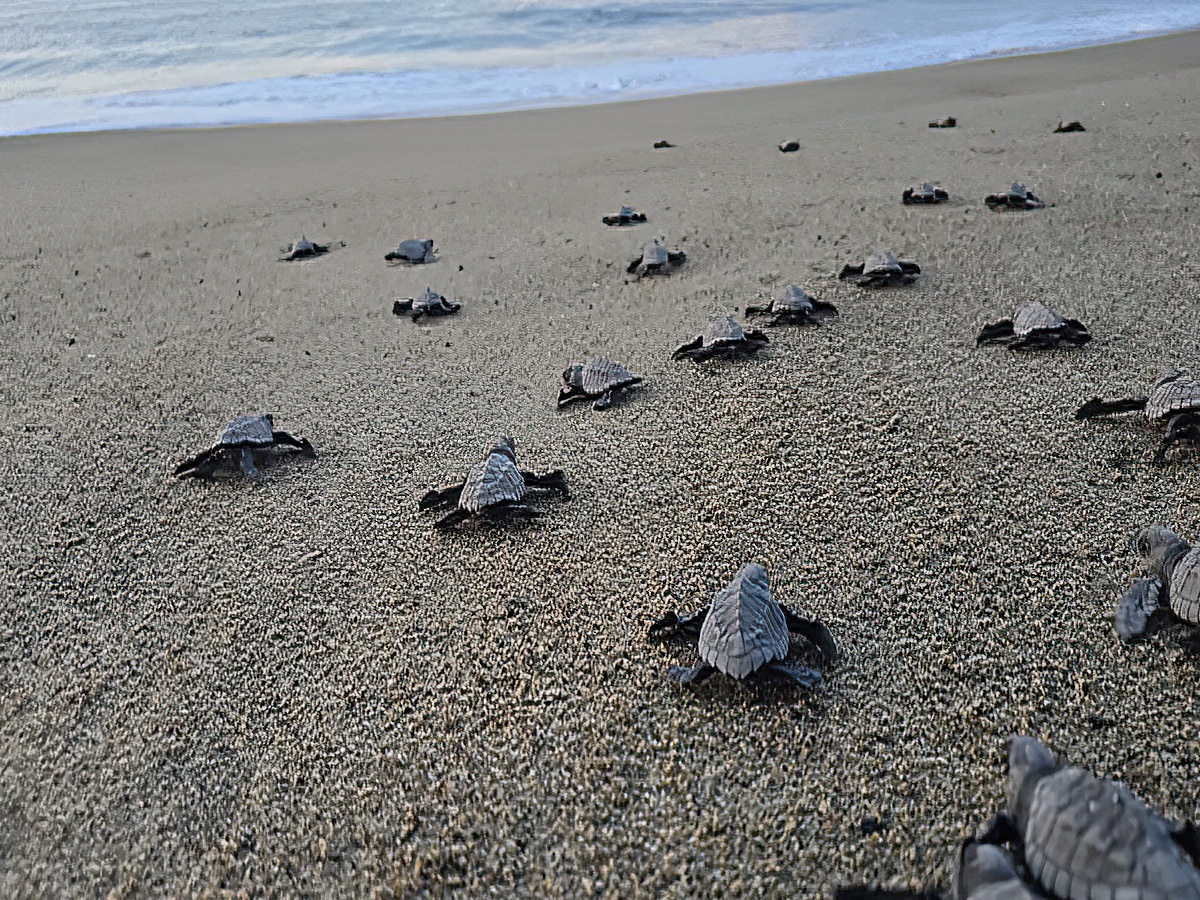
November to April Releases
Welcome to the Villa Star of the Sea Sea Turtle Preservation on beautiful Playa de Coco, Jalisco, Mexico, where nature, conservation, and the quiet rhythm of
the Pacific come together. Here, each season brings the wonder of nesting turtles and hatchlings returning to the sea. We invite you to
discover and celebrate one of the Costalegre's most meaningful natural treasures.
Our Seasonal Sea Turtle Preservation efforts are possible, through the kindness and generosity of patrons of La Sirena Gordita Restaurant, and Mark Vermeeren,
who wakes at 0345 hrs and drives to meet Eileen at 0415 Hrs every 2nd morning, November to AprIL, along with Coco "the Wonder Pup" to search for Sea Turtle clutches
to relocate to the Turtle Sanctuary at Villa Star of the Sea. Each excursion, our goal is only to find and relocate one or two turtle egg clutches to our sanctuary.
At the end of the season in April, after the last of the hatchlings are released, the sanctuary is dug up, and cleaned out, and new beach sand is placed into the sanctary
and in October maintenance and repairs are performed to ready for the new November season.
In Mexico, sea turtles and their eggs are protected under federal law, and the unauthorized collection, possession, disturbance, or destruction of turtle eggs can carry serious legal penalties. Because of that legal protection, our work at Villa Star of the Sea is carried out only under proper authority and within an approved conservation framework. We are certified and permitted through federal authorization associated with the University of Guadalajara, allowing us to lawfully recover and protect eggs for preservation purposes while supporting responsible conservation of these endangered species on Playa de Coco. As part of that work, we also maintain careful field monitoring, recording destroyed nests encountered during patrols, counting each egg collected, identifying the species, and tracking hatch rates from the sanctuary so that our preservation efforts remain responsible, informed, and accountable, and report back to the University of Guadalajara with these statistics.
Our hatchling releases, when we release, are done thirty minutes before sunrise, and fifteen minutes after sunset, when they are less vulnerable from land and sea preditors. They are released without notice. We traditionally do not announce our releases, ensuring focus making sure turtle hatchlings make it safely to the ocean. Coco stands guard at releases and will keep birds at bay, and crabs that might go after the hatchlings. She has been known to snap at people who get too close, and she has rescued hatchlings that have been pulled by crabs into their habitat.
A troubling pattern has emerged along the California coast, where a series of gray whale deaths has raised urgent questions about the growing pressures facing marine life. 🌊🐋 Within less than a month, seven whales have been found dead—an alarming number that has captured the attention of scientists, conservationists, and the public alike. The first discovery came on March 17, when an adult female gray whale was found lifeless, with early signs pointing to a suspected ship strike. It was a stark reminder of how modern maritime activity intersects with ancient migration routes that whales have followed for centuries. Since then, more bodies have been recovered, each adding weight to an already concerning situation. The most recent case involved a male gray whale found near Pier 19 in San Francisco, a busy urban waterfront where ships, ferries, and human activity are constant. For many, the image of such a powerful creature lying still in a place filled with movement is difficult to process. Gray whales are known for their long migrations, traveling thousands of miles between feeding grounds in the Arctic and breeding lagoons in Mexico. Along the way, they pass through some of the busiest shipping corridors in the world. As global trade increases, so does the risk of collisions. Ship strikes have become one of the leading causes of injury and death for large whales, often leaving little chance for survival. But vessel traffic is only one part of a larger picture. Environmental changes, food scarcity, and shifting ocean conditions may also be contributing factors. Warmer waters and changing ecosystems can affect the availability of the small organisms that gray whales rely on for nourishment. When combined with the stress of long migrations, these challenges can weaken even the strongest individuals. Marine experts are now working to examine each case carefully, conducting necropsies where possible to determine exact causes of death. These investigations are crucial—not just for understanding what happened to these seven whales, but for identifying patterns that could help prevent future losses. The situation has also reignited conversations about conservation measures. Slower vessel speeds in whale-populated areas, improved monitoring systems, and increased awareness among ship operators are all being discussed as ways to reduce risk. For now, the ocean holds its silence. The waves continue to move, the ships continue to pass, and the migration goes on. But beneath that surface, something has shifted—a reminder that the balance between human activity and marine life remains fragile. Each of these whales was more than a statistic. They were travelers, survivors, part of a story far older than our own. And their loss asks a question we can no longer ignore: how do we share the ocean… without taking too much from it?